Hi folks, tons of stuff hitting this week end so this will be short but heartfelt. I've seen authors at the point of despair and feel like I'm teetering close right now. So how does this pitfall work? It's the feeling you get after hundreds of submissions, hundreds of more queries, a number of almost published moments, and a ton of personal notes from many, many, publishing professionals that your works are PRETTY GOOD, but not good enough, for a number of reasons. I will tell you what I do to deal with it.
I keep working. You just don't go this far and give it up. It's not good sense.
I also do little things that perk me up -- go to an open reading, try writing something I haven't tried before, and daydream about the moment when someone says yes to my work. The only thing I'm sure of -- despair is a choking emotion, and it must be negated.
I fight for optimism. I keep a file of notes people have written to me about how much they enjoy my writing. I reread those. I talk to my writing friends about how I feel and this often cheers me up. I think about people who have persevered in much more trying circumstances than mine. I think about the future the most, instead of the past. Last, I hope. I let that thing with feathers perch in my soul.
Here is the deepest thing I know to do. I ask myself if my stories might make a difference. The answer is the one thing I am sure about. I think they will, and so I don't give up. I believe. That is all I can do.
Hope you climb out of the pit of despair if you are in it. I am sure of this too: if you quit, you will not succeed. :) Keep trying.
Here is my doodle: "Diving Bird" This was copied from a petroglyph in New Mexico. I like that the soul of the bird is a smiley face.
One of the things I learned the hard way was that it doesn’t pay to get discouraged. Keeping busy and making optimism a way of life can restore your faith in yourself. Lucille Ball
Explore the art and craft of writing with a healthy dose of inspiration for artists of all kinds.
Showing posts with label writing pitfalls. Show all posts
Saturday, July 27, 2013
Saturday, July 20, 2013
Pitfalls -- Stagnation
Hi, folks, I'm continuing my series on writing pitfalls. I've done several of these: Formula, Amalgam, Too Eager, No Velcro, Choking, Distraction This week is a problem I called stagnation.
You have a great idea and write the book, but something happens between the idea and production. The story falls apart. What you envision in your head is not working. You have produced an absolute mess. Your critique partners cringe when you bring it into group. Months roll into years, and you are still pecking this project that seems to never move forward. You are stagnating and this is not a good thing.
There are two outcomes for this project. One, you will reinvent it, or, two, you will let it go. There is no middle ground for this. The only way to solve stagnation is to shove the project in a drawer for a long while (at least a year). You will be able to save some of these projects, but not all. I have a few files that I've written on in bold caps: CLOSE THIS FILE RIGHT NOW! IT'S OVER. I don't delete projects; they may be organ donors, but I do know when it is time to turn my back on a story.
How? Identification. I stop pecking at the mess and name what is wrong with the thing. Your critique partners can help with this too. It might be a marketing problem: No one wants a picture book about kids killing bugs...your whole premise is just not going to work. It might be a plot problem: The twenty seven murders are dragging this book down. Not all the problems are glaring: Your fantasy world and real world might disconnect.
The bottom line, you must identify the manucscipt problem.Then fold your cards and get out of the game. Drain the writer's swamp by removing this blockage. Let the dang manuscript go and run with another idea.
I hope that you move out of any stagnant waters and streak forward with projects. This is like decluttering your house. You will breathe easier. I will be back next week with more good stuff.
Here is this week's doodle: "Flamingo!"
But I abhor the dull routine of existence. I crave for mental exaltation. Arthur Conan Doyle
You have a great idea and write the book, but something happens between the idea and production. The story falls apart. What you envision in your head is not working. You have produced an absolute mess. Your critique partners cringe when you bring it into group. Months roll into years, and you are still pecking this project that seems to never move forward. You are stagnating and this is not a good thing.
There are two outcomes for this project. One, you will reinvent it, or, two, you will let it go. There is no middle ground for this. The only way to solve stagnation is to shove the project in a drawer for a long while (at least a year). You will be able to save some of these projects, but not all. I have a few files that I've written on in bold caps: CLOSE THIS FILE RIGHT NOW! IT'S OVER. I don't delete projects; they may be organ donors, but I do know when it is time to turn my back on a story.
How? Identification. I stop pecking at the mess and name what is wrong with the thing. Your critique partners can help with this too. It might be a marketing problem: No one wants a picture book about kids killing bugs...your whole premise is just not going to work. It might be a plot problem: The twenty seven murders are dragging this book down. Not all the problems are glaring: Your fantasy world and real world might disconnect.
The bottom line, you must identify the manucscipt problem.Then fold your cards and get out of the game. Drain the writer's swamp by removing this blockage. Let the dang manuscript go and run with another idea.
I hope that you move out of any stagnant waters and streak forward with projects. This is like decluttering your house. You will breathe easier. I will be back next week with more good stuff.
Here is this week's doodle: "Flamingo!"
But I abhor the dull routine of existence. I crave for mental exaltation. Arthur Conan Doyle
Saturday, July 13, 2013
Pitfalls -- Amalgam
Hi folks, this month I writing a series about creative pitfalls. Last week I touched on the pitfall of formula. This week's pitfall is called amalgam. I see this in published books sometimes and in my own work (sigh). This is when a content creator brings together a mishmash of ideas -- good ideas -- and then fails to synthesize them into something cohesive. Cough, cough, movie analogy -- Cloud Atlas. I love you, Lana, Andy and Tom. David Mitchell wrote an amazing book, but you three didn't synthesize this and yikes. I do give you props for ambition.
How do you fall into the pitfall of amalgam? You aren't trusting your good ideas, and hence you've gone into the work of others in search of beefy bits to give your story some ooomph. You set out to write a classic regency romance novel. Sparks fly between Jane and her Mr. Bingley. It's innovative and working. Then you read this really great book about time travel, and low and behold, a thieving time traveller -- think Eric Bana -- shows up in your novel, in search of a cursed star sapphire and he seduces your Jane.
Oh, then you read a great conspiracy thriller and decide to mix in some political intrigue about the medieval masons. Jane is the last in a line of powerful steampunk wizards and must kill Mr. Bingley to prove her loyalty to the guild and take down that thieving time traveller, because the cursed star sapphire is part of a magic scepter used to keep Underworld demons at bay. This is not turning out to be a very satisfying romance.
You've written 150K words of your book with no end in sight, and you don't really know what your book is about anymore. You flail around, and wonder what happened. You shove this manuscript into the box at the back of closet that already has 10 other manuscripts in it -- all failed attempts. The good news is all this failure is really a good thing. You need persistence to succeed as a writer.
The bad news is this is not a pile of genius that is overlooked. You have created a pile of a lack of confidence. How are you ever going to get on track? Well, stop being so hard on yourself and try having some fun. Relax. Your best content comes from your emotional core. You obviously like a lot of different kinds of books and mashup isn't an impossible thing, but you are the glue that is going to make it work. You have to take control of your writing life, what do you want? Focus. Classic regency romance? Do that. Something else? Fine, but define it and stick to YOUR vision.
At the end of the day, I 'm not saying to don't mix elements. But if you do, you need to synthesize them and you need to own them. Don't let all the work of others bleed into your book. Be inspired. Be bolstered. But don't be a book cannibal.
So pull out that manuscript that haunts you and start cutting out that bloody mess that has infected your great book. You have always felt there is a good book in there. Believe in your vision. Add in your unique slant. Synthesize. Do it. Climb out of the pit. See you next week with more writer pitfalls.
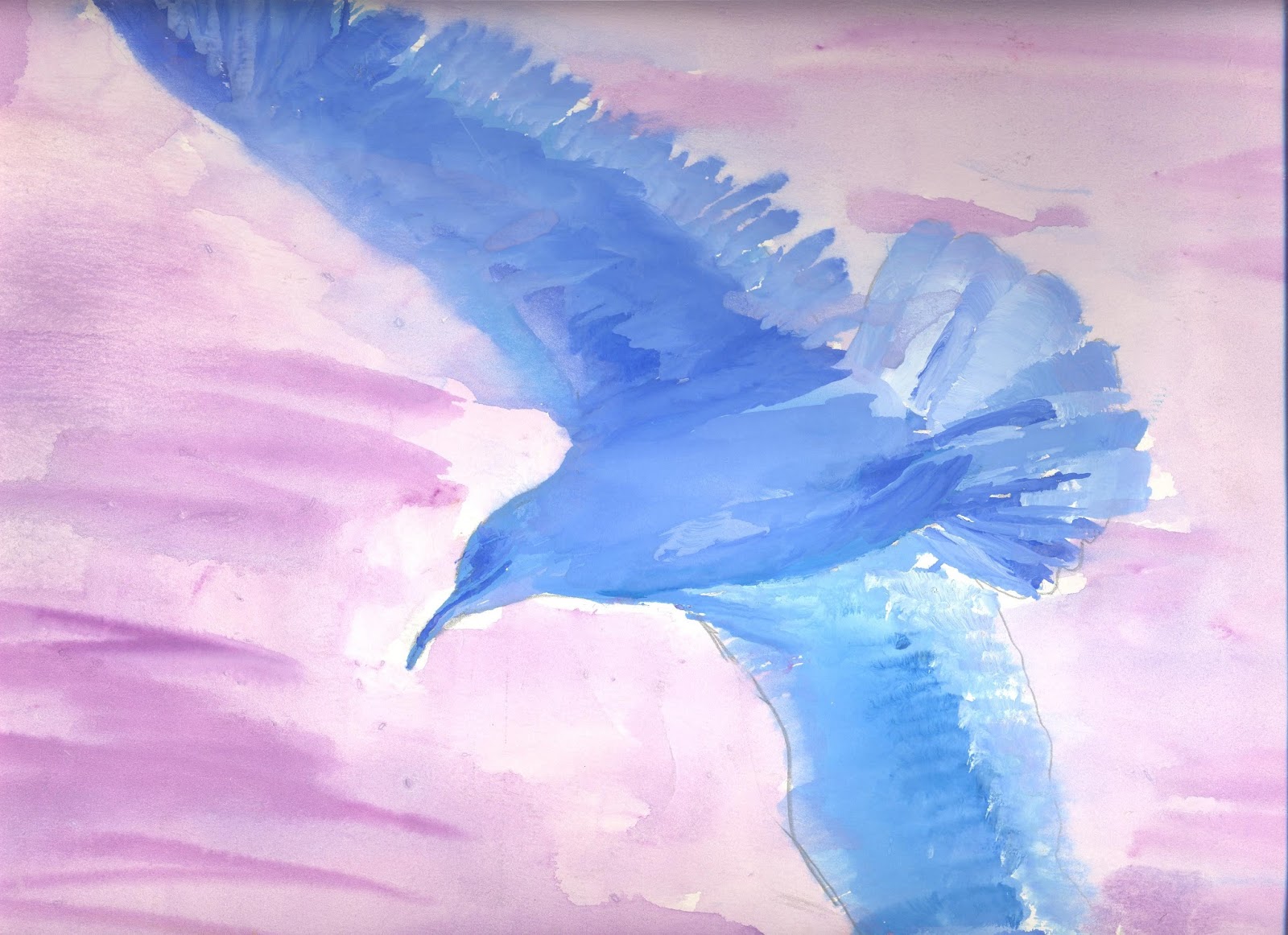
This week's doodle is called: Blue Seagull.
How do you fall into the pitfall of amalgam? You aren't trusting your good ideas, and hence you've gone into the work of others in search of beefy bits to give your story some ooomph. You set out to write a classic regency romance novel. Sparks fly between Jane and her Mr. Bingley. It's innovative and working. Then you read this really great book about time travel, and low and behold, a thieving time traveller -- think Eric Bana -- shows up in your novel, in search of a cursed star sapphire and he seduces your Jane.
Oh, then you read a great conspiracy thriller and decide to mix in some political intrigue about the medieval masons. Jane is the last in a line of powerful steampunk wizards and must kill Mr. Bingley to prove her loyalty to the guild and take down that thieving time traveller, because the cursed star sapphire is part of a magic scepter used to keep Underworld demons at bay. This is not turning out to be a very satisfying romance.
You've written 150K words of your book with no end in sight, and you don't really know what your book is about anymore. You flail around, and wonder what happened. You shove this manuscript into the box at the back of closet that already has 10 other manuscripts in it -- all failed attempts. The good news is all this failure is really a good thing. You need persistence to succeed as a writer.
The bad news is this is not a pile of genius that is overlooked. You have created a pile of a lack of confidence. How are you ever going to get on track? Well, stop being so hard on yourself and try having some fun. Relax. Your best content comes from your emotional core. You obviously like a lot of different kinds of books and mashup isn't an impossible thing, but you are the glue that is going to make it work. You have to take control of your writing life, what do you want? Focus. Classic regency romance? Do that. Something else? Fine, but define it and stick to YOUR vision.
At the end of the day, I 'm not saying to don't mix elements. But if you do, you need to synthesize them and you need to own them. Don't let all the work of others bleed into your book. Be inspired. Be bolstered. But don't be a book cannibal.
So pull out that manuscript that haunts you and start cutting out that bloody mess that has infected your great book. You have always felt there is a good book in there. Believe in your vision. Add in your unique slant. Synthesize. Do it. Climb out of the pit. See you next week with more writer pitfalls.
This week's doodle is called: Blue Seagull.
I'm closing up with a quote for your pocket.
Some things are destined to be -- it just takes us a couple of tries to get there. Jessica Rowley Pell Bird as J.R Ward
Saturday, July 06, 2013
Pitfalls -- Formula
Hi, folks, this month I'm going to dig into pitfalls that writers fall into from time to time. I will spend the month of June uncovering hidden hazards in writing. Please check out my earlier series on Pitfalls too. So here goes.
One pitfall many writers fall into is formula. There are stacks of writing books out and writers gobble these up. Faves include Robert McKee's Story, Francine Prose's Reading Like a Writer, Natalie Goldberg's Writing Down the Bones, the Elements of-- series. Yes, these stacks are good books and offer great advice. But here's the deal, the most important part of writing isn't in the books. The most important part of writing is who you are and what you want.(Mythic!)
A novel to me is akin to sailing a ship around a world on a sea no one has never been charted. I'm a voracious reader and I know that many writers stay close to the shore, don't take risks, and end up producing hopelessly mediocre work. And what really kills me is they can do more. I will see evidence of more but they don't do it. Consider this, formula may be holding you back. Don't get me wrong, formula is not a bad thing, but it's like acetaminophen, too much of it will poison you.
So how do you know if you have fallen into this pit? You are surely in the pit in you are trying to mimic another author. Listen to my kindergarten teacher Ms. Crabtree: be yourself. You are in the pit if you read stacks of writing books, but you sort hate the work you are producing. Stop that right now. You are in the pit if you avoid the place you want to go in your story because it goes against the rules. Break the "rules", dang it! You are in the pit if you have abandoned a project you love because folks have told you it is too out there. I say, go there. You may sink the ship, or you may discover a new world.
I hope that you zoom forward this week with your projects. Thanks for dropping by. I will be back next week with more of this series. Seize the day.
Here is the doodle for the week: Owl.
Your quote for the week.
I am the master of my fate:I am the captain of my soul. William Ernest Henly
One pitfall many writers fall into is formula. There are stacks of writing books out and writers gobble these up. Faves include Robert McKee's Story, Francine Prose's Reading Like a Writer, Natalie Goldberg's Writing Down the Bones, the Elements of-- series. Yes, these stacks are good books and offer great advice. But here's the deal, the most important part of writing isn't in the books. The most important part of writing is who you are and what you want.(Mythic!)
A novel to me is akin to sailing a ship around a world on a sea no one has never been charted. I'm a voracious reader and I know that many writers stay close to the shore, don't take risks, and end up producing hopelessly mediocre work. And what really kills me is they can do more. I will see evidence of more but they don't do it. Consider this, formula may be holding you back. Don't get me wrong, formula is not a bad thing, but it's like acetaminophen, too much of it will poison you.
So how do you know if you have fallen into this pit? You are surely in the pit in you are trying to mimic another author. Listen to my kindergarten teacher Ms. Crabtree: be yourself. You are in the pit if you read stacks of writing books, but you sort hate the work you are producing. Stop that right now. You are in the pit if you avoid the place you want to go in your story because it goes against the rules. Break the "rules", dang it! You are in the pit if you have abandoned a project you love because folks have told you it is too out there. I say, go there. You may sink the ship, or you may discover a new world.
I hope that you zoom forward this week with your projects. Thanks for dropping by. I will be back next week with more of this series. Seize the day.
Here is the doodle for the week: Owl.
Your quote for the week.
I am the master of my fate:I am the captain of my soul. William Ernest Henly
Saturday, July 28, 2012
Pitfalls -- Distraction
Hi folks, I hope you are working this week. I'm going to wrap up my pitfalls series this week. This last writing pitfalls I'm going to cover is distraction and is considered another cause for choking. I talked about the other cause -- "paralysis of analysis" -- last week. Again, I'm borrowing from other fields here -- sports and math performance -- and what they've learned about distraction
So what is distraction? You checked your Facebook, wrote your blog, updated your twitter, commented on several boards, wrote a writing article, volunteered for a conference, revised your website, researched agents, read a book on writing, and didn't have any time to work on your novel. You, my friend, are distracted and are this is no way to write your books.
Why are you distracted? You have a system in your brain system. This system actively holds information in the mind to do tasks. This system is called your SHORT TERM MEMORY. Distraction is about an overloaded short term memory. Writing a novel is already a multi-tasking job. Now, your short term memory has become full of ancillary tasks -- creating a network and building a platform. Your mind is full of these tasks because many publishing voices are putting pressure on you to do them. These voices have you worried. These ancillary tasks have drawn you away from the primary task of "writing the dang book."
You are now in a multi-task weighted environment that has exceeded the limits of you short term memory. This multi-tasking environment puts especially high pressure on newbie writers because they lack writing experience that helps a veteran writer stay focused when the pressure is on. There are some things you can do to alleviate this situation. Compartmentalize. Dedicate one day a week to your ancillary tasks and the rest of days work on your main task. Build in a system of rewards. Athletes understand they must have a reward to train. Not all pressure is bad. Something about getting a gold medal puts the right kind of pressure on the participant to push past distractions.
Seek an audience for your writing. This is writing on display, especially in front of experts in field and will put pressure on you to limit distractions. Freelance. Newbies are at a disadvantage and can help themselves by piling on experience. I remember hearing a famed children's editor years ago saying you need to take any writing job for pay that comes your way. Write menus for restaurants if you have to, he encouraged. A writing job will sharpen your skills. A writing job comes with rewards (pay), an audience (an editor and readership) and the heat of a deadline. The more experience you have the less likely you are to choke when you move forward with a mammoth novel projects. Seek pressures that will make you excel.. Even a volunteer writing position will help. Experience will hone the automatic skills you need to write when the heat is on.
I hope you see that the proper writing environment is fragile. It must be tended and tweaked. You need to think about the number of tasks you can reasonably perform and then let the rest go. You need shift some of your time tasks that bring your the right kind of experience. If all your tweeting is building an audience with experts in the field, keep at that, but ditch the Facebook, the boards, the blogs, etc. Read experts books with a critique group and hold each other accountable to implementing knowledge in the book. Are you getting the picture? Create an environment that is conductive to the production of a product and limits distractions.
Okay, I can't cover everything in the universe about distraction here, but I hope this little discussion helps you get on the path to book production. Seize the day.
So what is distraction? You checked your Facebook, wrote your blog, updated your twitter, commented on several boards, wrote a writing article, volunteered for a conference, revised your website, researched agents, read a book on writing, and didn't have any time to work on your novel. You, my friend, are distracted and are this is no way to write your books.
Why are you distracted? You have a system in your brain system. This system actively holds information in the mind to do tasks. This system is called your SHORT TERM MEMORY. Distraction is about an overloaded short term memory. Writing a novel is already a multi-tasking job. Now, your short term memory has become full of ancillary tasks -- creating a network and building a platform. Your mind is full of these tasks because many publishing voices are putting pressure on you to do them. These voices have you worried. These ancillary tasks have drawn you away from the primary task of "writing the dang book."
You are now in a multi-task weighted environment that has exceeded the limits of you short term memory. This multi-tasking environment puts especially high pressure on newbie writers because they lack writing experience that helps a veteran writer stay focused when the pressure is on. There are some things you can do to alleviate this situation. Compartmentalize. Dedicate one day a week to your ancillary tasks and the rest of days work on your main task. Build in a system of rewards. Athletes understand they must have a reward to train. Not all pressure is bad. Something about getting a gold medal puts the right kind of pressure on the participant to push past distractions.
Seek an audience for your writing. This is writing on display, especially in front of experts in field and will put pressure on you to limit distractions. Freelance. Newbies are at a disadvantage and can help themselves by piling on experience. I remember hearing a famed children's editor years ago saying you need to take any writing job for pay that comes your way. Write menus for restaurants if you have to, he encouraged. A writing job will sharpen your skills. A writing job comes with rewards (pay), an audience (an editor and readership) and the heat of a deadline. The more experience you have the less likely you are to choke when you move forward with a mammoth novel projects. Seek pressures that will make you excel.. Even a volunteer writing position will help. Experience will hone the automatic skills you need to write when the heat is on.
I hope you see that the proper writing environment is fragile. It must be tended and tweaked. You need to think about the number of tasks you can reasonably perform and then let the rest go. You need shift some of your time tasks that bring your the right kind of experience. If all your tweeting is building an audience with experts in the field, keep at that, but ditch the Facebook, the boards, the blogs, etc. Read experts books with a critique group and hold each other accountable to implementing knowledge in the book. Are you getting the picture? Create an environment that is conductive to the production of a product and limits distractions.
Okay, I can't cover everything in the universe about distraction here, but I hope this little discussion helps you get on the path to book production. Seize the day.
Here is this week's doodle:: "Wide open sky."
Finally, I add a quote:
Sometimes adversity is what you need to face in order to become successful. Zig Ziglar
Saturday, July 14, 2012
Pitfalls -- No Velcro
Hi folks, I'm coming in today with an idea that comes from one of my writerly friends Kathy Whitehead. She's the author of two picture books Art From Her Heart and Looking For Uncle Louie on the Fourth of July. Recently she was reading one of my chapters in critique group and came back with this: Your writing is too slick. It lacks velcro.
So velcro is a fastener that consists of a fabric component that features tiny hooks and a second that features even smaller and "hairier" loops. When you touch the pieces together, they lock. Many people say that a book needs a strong hook at the beginning but neglect to realize the rest of the novel needs to be peppered with hooks. This mass of hooks will keep your readers glued to your work until the end.
A big pitfall that I have run into is not peppering the work with the tons of hooks needed to keep readers ingrossed. One writer who does a fab job of peppering her work with hooks is J.K. Rowling. I mean the lusciousnes of her world building just keeps you glued. Wands, butterbeer, Bertie Botts Jelly Beans, magical chocolate frogs, sorting hats, Quiddich...all the little details that serve as tiny hooks to keep us stuck to the story.
Characters need hobbies, quirks, favorite sports, best drinks, etc. Look at every descriptive detail as an opportunity to hook your reader. Remember never put a piece of cardboard in the place there should be a hook. Make your readers care.
Consider this too. Volume does not make a description have a hook. It's about interest not about amount. Hooks always include sharp smart writing and new twists on dry-as-toast ideas. So dig into your smooth bland work and add the hooks.
I hope you add the velcro to the work this week! Come back next week for more pitfalls to avoid.
As human beings, our greatness lies not so much in being able to remake the world - that is the myth of the atomic age - as in being able to remake ourselves. Mahatma Gandhi
So velcro is a fastener that consists of a fabric component that features tiny hooks and a second that features even smaller and "hairier" loops. When you touch the pieces together, they lock. Many people say that a book needs a strong hook at the beginning but neglect to realize the rest of the novel needs to be peppered with hooks. This mass of hooks will keep your readers glued to your work until the end.
A big pitfall that I have run into is not peppering the work with the tons of hooks needed to keep readers ingrossed. One writer who does a fab job of peppering her work with hooks is J.K. Rowling. I mean the lusciousnes of her world building just keeps you glued. Wands, butterbeer, Bertie Botts Jelly Beans, magical chocolate frogs, sorting hats, Quiddich...all the little details that serve as tiny hooks to keep us stuck to the story.
Characters need hobbies, quirks, favorite sports, best drinks, etc. Look at every descriptive detail as an opportunity to hook your reader. Remember never put a piece of cardboard in the place there should be a hook. Make your readers care.
Consider this too. Volume does not make a description have a hook. It's about interest not about amount. Hooks always include sharp smart writing and new twists on dry-as-toast ideas. So dig into your smooth bland work and add the hooks.
I hope you add the velcro to the work this week! Come back next week for more pitfalls to avoid.
Here is this week's doodle: "Lamb".
And finally this week's quote:
Saturday, July 07, 2012
Writing Pitfalls -- Too Eager
Hi folks, I'm starting a new series in July about pitfalls in writing. This will be short but heartfelt. I've fallen into a number of pits in my writing journey, and I hope that some of my falls will help you find good success with fewer skinned knees.
My first pitfall is called "Too Eager." Oh, I do look longingly at folks who seem to jump out of the nest and soar into the sky instead of slamming their way down a bunch of branches and landing in a heap on the forest floor. Over eagerness is a true pitfall. Different kinds of birds fly at different times. Stop comparing yourself to others. (I mean it. STOP!) You must wait until your writing matures before you get to move forward. Your worth is not part of your work, so if you have those two things connected, please disconnect them now. Appearing desperate is not the way to get published. Confidence is something that is born in you. It comes with your experience. Let it grow.
It can be a blow to the ego to write your first fab book and then have all the gatekeepers say no. Then you write another book and they say no. Around book 5 or 6 they start saying you are better than 99% of what they see and still they say no. Dang, gatekeepers. You have some choices. Don't take things too personally. Publishing is a competitive business and you are doing an excellent job by getting your books into honest discussions. Write your next book. Open up to new ideas. Innovate. Spread good karma. Celebrate your work. Enjoy it and keep trying. I have never seen a dedicated creative person fail. Not one time.
I hope this little discussion helps keep you on your true course. Keep creating and I will see you next with for another friendly chat about pitfalls and what you should do.
I believe in pink. I believe that laughing is the best calorie burner. I believe in kissing, kissing a lot. I believe in being strong when everything seems to be going wrong. I believe that happy girls are the prettiest girls. I believe that tomorrow is another day and I believe in miracles. Audrey Hepburn
My first pitfall is called "Too Eager." Oh, I do look longingly at folks who seem to jump out of the nest and soar into the sky instead of slamming their way down a bunch of branches and landing in a heap on the forest floor. Over eagerness is a true pitfall. Different kinds of birds fly at different times. Stop comparing yourself to others. (I mean it. STOP!) You must wait until your writing matures before you get to move forward. Your worth is not part of your work, so if you have those two things connected, please disconnect them now. Appearing desperate is not the way to get published. Confidence is something that is born in you. It comes with your experience. Let it grow.
It can be a blow to the ego to write your first fab book and then have all the gatekeepers say no. Then you write another book and they say no. Around book 5 or 6 they start saying you are better than 99% of what they see and still they say no. Dang, gatekeepers. You have some choices. Don't take things too personally. Publishing is a competitive business and you are doing an excellent job by getting your books into honest discussions. Write your next book. Open up to new ideas. Innovate. Spread good karma. Celebrate your work. Enjoy it and keep trying. I have never seen a dedicated creative person fail. Not one time.
I hope this little discussion helps keep you on your true course. Keep creating and I will see you next with for another friendly chat about pitfalls and what you should do.
Here is a little doodle: "A Row of Kids".
Saturday, February 25, 2012
Golden Advice: Turn the Page
Hi, folks, another week has rolled by. One big job of the writer is to get the reader to turn the page. My understanding about this is born out of my life long love of reading. I actually read very few books that make me want to turn every page. Today I will write about three lessons I've learned about turning the page from a reader's perspective.
1. A good start but it falls apart -- In this case, the writer really has some compelling characters, knows how to find the moment when everything changes, and understands how to launch the adventure. Then everything falls apart. The characters usually whine and cry a lot and the stakes don't rise, someone other than the main character solves the story problem, and finally there is the dreaded overhanded preachy message. I really moan at this kind of book because, like I said, they had a good start. I need more than a premise to turn the page.
2. A main character I just can't respect -- This happens in some books. The main character will put up with something I just don't believe should be put up with. The main character is abused or abuses in a way that seems unreliable and unsound. Another fatal character flaw is no of emotional roller coaster. It's difficult to really keep turning the page with someone who never laughs, is never angry, is never contemplative or ever worse is always one of these things. A sound character with a believable emotional arc will encourage me to turn the page.
3. Not enough stuff happening -- This happens in a lot of books. I will mention that I don't remember reading a book that I felt too much was happening. No, the real problem is dull stretches in every other book I read. One dull stretch is the endless conversation. The character is jabbering on with someone else and it's usually because the writer doesn't trust me to "get" the main character's motivation. I "get" it. Another dull stretch, I'm waiting for the terrible thing to happen, I know what it is, I'm waiting, and waiting, and waiting. When the terrible thing happens, I can always feel my eyes roll, and the word "finally" pops in my head. Last, I really don't care if there is mocha paint with cherries on the wall, is he going kill his stepfather or not? That's what I'm really into. Long boring descriptions of the setting -- no. I need stuff to happen to turn the page, I really do.
Well, writers, I hope this reader has given you an idea or two about what you should be doing. Keep working on your stories. BTW, I think this advice works for artist storytellers too. Seize the day!
Here is this week's doodle: "Girl"

Quote for the week:
It is not enough to simply teach children to read; we have to give them something worth reading. Something that will stretch their imaginations--something that will help them make sense of their own lives and encourage them to reach out toward people whose lives are quite different from their own. Katherine Patterson
1. A good start but it falls apart -- In this case, the writer really has some compelling characters, knows how to find the moment when everything changes, and understands how to launch the adventure. Then everything falls apart. The characters usually whine and cry a lot and the stakes don't rise, someone other than the main character solves the story problem, and finally there is the dreaded overhanded preachy message. I really moan at this kind of book because, like I said, they had a good start. I need more than a premise to turn the page.
2. A main character I just can't respect -- This happens in some books. The main character will put up with something I just don't believe should be put up with. The main character is abused or abuses in a way that seems unreliable and unsound. Another fatal character flaw is no of emotional roller coaster. It's difficult to really keep turning the page with someone who never laughs, is never angry, is never contemplative or ever worse is always one of these things. A sound character with a believable emotional arc will encourage me to turn the page.
3. Not enough stuff happening -- This happens in a lot of books. I will mention that I don't remember reading a book that I felt too much was happening. No, the real problem is dull stretches in every other book I read. One dull stretch is the endless conversation. The character is jabbering on with someone else and it's usually because the writer doesn't trust me to "get" the main character's motivation. I "get" it. Another dull stretch, I'm waiting for the terrible thing to happen, I know what it is, I'm waiting, and waiting, and waiting. When the terrible thing happens, I can always feel my eyes roll, and the word "finally" pops in my head. Last, I really don't care if there is mocha paint with cherries on the wall, is he going kill his stepfather or not? That's what I'm really into. Long boring descriptions of the setting -- no. I need stuff to happen to turn the page, I really do.
Well, writers, I hope this reader has given you an idea or two about what you should be doing. Keep working on your stories. BTW, I think this advice works for artist storytellers too. Seize the day!
Here is this week's doodle: "Girl"

Quote for the week:
It is not enough to simply teach children to read; we have to give them something worth reading. Something that will stretch their imaginations--something that will help them make sense of their own lives and encourage them to reach out toward people whose lives are quite different from their own. Katherine Patterson
Saturday, January 21, 2012
Writing Novels: 5 Things that Don't Work
I am spending the month sharing this and that about my novel writing journey. Today I'm going to chat about 5 things that have absolutely not worked on my journey. Perhaps my missteps will help you.
1. Changing POV because someone suggested it -- I have changed the POV from first person to third person and back again a number of times because either a critique group partner, a teacher, an agent or an editor suggested the move. My experience with this advice is that the first couple of times it was a good exercise but ultimately I learned that POV is a decision that a writer must chose from her internal sense of how her story should be told. You need to dig into yourself and find your POV. Never change POV unless it is an internal decision. If someone suggested it, you better go into it with your reasons and no one else's.
2. Hurrying -- I have found you must let your novels grow at their own pace. Revisions must be performed at their own pace. Get to know your rhythms and don't rush. I know that the whole NANOWRIMO thing helps some folks move past procrastination but this advice is different. Every author finds a natural rhythm to create books. You may find you are not as fast as other writers. My best advice if you are slow, embrace it and don't hurry. Find agents and editors who can relate to your natural rhythms.
3. No Project Management -- Novels are big projects and they need project management. If you do not have a document aside from your book filled with character sketches, setting notes, outlines or summaries, spread sheets with scene pacing, etc., I doubt your novel is going to fly. I know my won't. Get a three ring binder, a beautiful blank book and some note cards or try ONENOTE or SCRIVNER or DRAMATICA and move into the world of successful novel creation with decent project management.
4. Focusing on the first chapter -- Oh, I have done this and I have seen so many others do this. A novel is a journey through multiple chapters. You must balance your attention on each chapter. If you have rewritten that first chapter 40 times and you have not rewritten your fortieth chapter 40 times, you are messing up. Every chapter must receive balanced attention to create a master work.
5. Staring at the computer screen -- I found that my novels were not getting polished enough because I was not searching out the reader experience. I find that I must print out my novel to get a good sense of where I'm at. Write a book that is shelf ready. I put my books on my Kindle. I change the fonts. I read the book aloud and then listen to the recording while reading the pages at the same time. Search out the experience of a reader reading your book. This will help you create a viable novel.
I hope my thoughts here help you write your own work. Come back next week. Seize the day.
This week's doodle is "From My Sketchbook":
Something true but I don't understand it.
Great, big, serious novels always get awards. If it's a battle between a great, big, serious novel and a funny novel, the funny novel is doomed. Neil Gaiman
1. Changing POV because someone suggested it -- I have changed the POV from first person to third person and back again a number of times because either a critique group partner, a teacher, an agent or an editor suggested the move. My experience with this advice is that the first couple of times it was a good exercise but ultimately I learned that POV is a decision that a writer must chose from her internal sense of how her story should be told. You need to dig into yourself and find your POV. Never change POV unless it is an internal decision. If someone suggested it, you better go into it with your reasons and no one else's.
2. Hurrying -- I have found you must let your novels grow at their own pace. Revisions must be performed at their own pace. Get to know your rhythms and don't rush. I know that the whole NANOWRIMO thing helps some folks move past procrastination but this advice is different. Every author finds a natural rhythm to create books. You may find you are not as fast as other writers. My best advice if you are slow, embrace it and don't hurry. Find agents and editors who can relate to your natural rhythms.
3. No Project Management -- Novels are big projects and they need project management. If you do not have a document aside from your book filled with character sketches, setting notes, outlines or summaries, spread sheets with scene pacing, etc., I doubt your novel is going to fly. I know my won't. Get a three ring binder, a beautiful blank book and some note cards or try ONENOTE or SCRIVNER or DRAMATICA and move into the world of successful novel creation with decent project management.
4. Focusing on the first chapter -- Oh, I have done this and I have seen so many others do this. A novel is a journey through multiple chapters. You must balance your attention on each chapter. If you have rewritten that first chapter 40 times and you have not rewritten your fortieth chapter 40 times, you are messing up. Every chapter must receive balanced attention to create a master work.
5. Staring at the computer screen -- I found that my novels were not getting polished enough because I was not searching out the reader experience. I find that I must print out my novel to get a good sense of where I'm at. Write a book that is shelf ready. I put my books on my Kindle. I change the fonts. I read the book aloud and then listen to the recording while reading the pages at the same time. Search out the experience of a reader reading your book. This will help you create a viable novel.
I hope my thoughts here help you write your own work. Come back next week. Seize the day.
This week's doodle is "From My Sketchbook":

Something true but I don't understand it.
Great, big, serious novels always get awards. If it's a battle between a great, big, serious novel and a funny novel, the funny novel is doomed. Neil Gaiman
Subscribe to:
Posts (Atom)